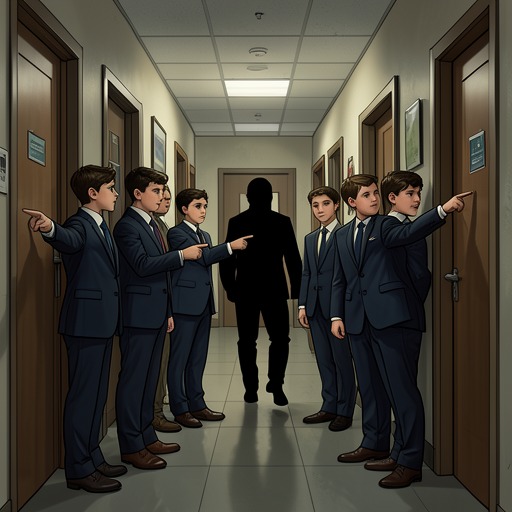
Mrs Bortz’s snooping in Fenton Prentice’s apartment
The Mystery of The Invisible DogMrs Bortz’s snooping in Fenton Prentice’s apartment is the human trespass behind what had seemed to be a haunting. The Three Investigators approach the problem not by accepting the shadowy presence as supernatural, but by testing the physical clues left by someone who entered, searched Prentice’s desk, and departed through an ordinary door. The solution turns on the difference between an imagined intruder and a real one with a copied key.
Suspicion and the Apartment
Prentice had already found that his desk had been gone through, and the invasions had unsettled him enough to make the apartment seem haunted. Yet suspicion of Mrs Bortz did not begin with the desk alone. Prentice described her as a relentless busybody who asked impertinent questions and sometimes searched the dustbins. He had caught her doing so, and her familiarity with the residents’ private habits struck him as evidence of how closely she pried into their lives.
The details made that suspicion concrete. Mrs Bortz knew that Gwen Chalmers ate frozen dinners and that Alex Hassell’s group of stray cats consumed more than forty cans of pet food a week. Those facts did not by themselves prove that she had entered Prentice’s home, but they established a pattern of intrusive curiosity beyond the apartment door. The question was whether that same curiosity had given her access to his papers.
The Ointment Test
Jupiter’s test focused on the desk drawers rather than on the supposedly unaccountable presence. The drawer knobs were ceramic, so Investigative ointment could be applied to them without damaging the material: the chemical reacted with metal, potentially harming copper or brass, but not ceramics. If someone opened a drawer while the boys were away, the ointment would leave black stains on that person’s hands. The arrangement converted a vague report of disturbance into a specific, physical test of entry.
Prentice objected that a presence able to come and go seemed capable of ignoring doors and solid walls; a drawer handle, he asked, should not stop it. Jupiter’s answer was practical rather than supernatural. Prentice had said that the desk had been searched, so the investigators coated the knobs and left the apartment. Jupiter used a paper towel to take the ointment from its jar, then went out with Pete Crenshaw, Bob Andrews, and Prentice. They walked slowly downstairs, talking loudly about where they planned to eat, while the courtyard was empty. At the gate, they encountered Mrs Bortz and Sonny Elmquist looking toward the church, where an ambulance stood.
When the boys later inspected the desk, Jupiter used a small magnifying glass to examine its handles. His next deduction supplied the test’s meaning: whoever had opened a drawer could not do so without getting smudges on their fingers. The intruder had also left that morning in the usual way, by opening the apartment door. Jupiter concluded that the person was someone who lived in the building and had seen the boys leave. The method narrowed the possibilities through ordinary movements—touching a drawer, using a door, watching the investigators depart—rather than through any supposed power to pass through walls.
The Key and the Intruder
The decisive explanation emerged when Prentice acknowledged that Mrs Bortz possessed a key. He had a special clause in his lease forbidding the building manager from entering his apartment, and he had initially insisted that the intruder must have gained access by means of a second key. Mrs Bortz had obtained one while Prentice was in Europe two months earlier. She called a locksmith who often worked for her and claimed that she had lost the key and needed to enter to check a leak in a pipe. Trusting her authority, the locksmith removed the lock, made a key, and replaced the lock.
That account explains how the apartment could be entered without a broken door or an impossible passage through solid walls. It also clarifies why the desk was vulnerable: Mrs Bortz had a working key, and her private curiosity supplied a pattern consistent with the rummaged papers. Prentice said he took the key from her. He was grateful to the boys for identifying the person who had been going through his desk and snooping into his papers, and considered contacting the Martin Company, which owned the building, about the violation of his lease.
Resolution and Significance
For Prentice, identifying Mrs Bortz changed the character of the disturbance. He admitted that he was relieved to learn that a real person had been entering the apartment. He now thought he might have imagined the shadowy presence because he was so upset by the invasion of his home; Mrs O’Reilly’s ghost stories, he suggested, may have furnished ideas that shaped his fear. His response does not erase the actual violation. It separates the real trespass from the supernatural explanation he had begun to accept.
The episode’s resolution rests on a carefully material chain of reasoning: a searched desk, ceramic handles treated with a chemical, smudges as a sign of contact, an ordinary exit, and a key obtained through a false pretext. Mrs Bortz’s wider habit of prying gives the discovery a human context, while the lease clause makes clear that her access was unauthorized even though she was the building manager. The apparent haunting ends not with proof of a ghost, but with the recognition that a familiar neighbor could cross a private boundary—and that a physical trace and a copied key could expose her.